
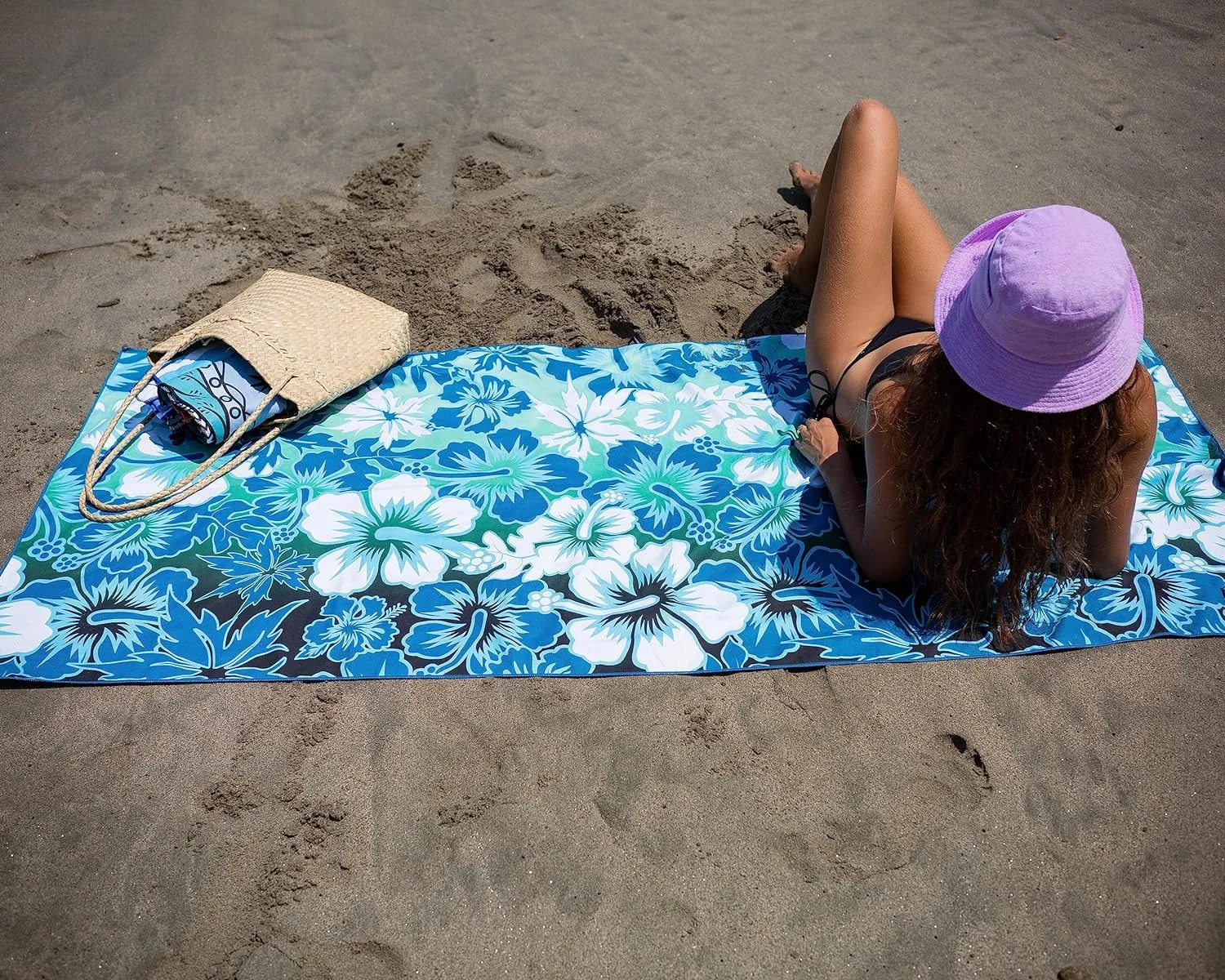
A beach towel needs enough room for the way it will be used: drying after a swim, lying on sand, covering a lounger or wrapping around the body. Start with the required coverage, then check the fabric weight and folded size. A larger towel gives more surface area, but it also changes what customers carry and what your business packs, stores and ships.
This guide gives dimensions in centimeters and inches, explains rectangular, round and hooded formats, and shows how to turn a preferred size into a clear manufacturing specification.
Beach Towel Size Chart: Where to Start
For an adult rectangular towel, compare 70 × 140 cm, 80 × 160 cm and 100 × 180 cm as starting points. The smaller format favors portability; more width and length provide more room for reclining or wrapping. For extended coverage, compare oversized options from 100 × 200 cm to 120 × 240 cm.
These are planning examples, not international size standards or a promise that every fabric is available in every dimension. Specify actual measurements instead of relying on labels such as “standard,” “large” or “XL.”
Swipe or scroll horizontally to see all columns →
| Size in centimeters | Approximate inches | Possible use | Check before choosing |
|---|---|---|---|
| 50 × 90 cm | 19.7 × 35.4 in | Small drying towel or accessory | Limited reclining and adult wrap coverage |
| 70 × 140 cm | 27.6 × 55.1 in | Portable beach or pool towel | Whether the length suits the intended users |
| 80 × 160 cm | 31.5 × 63.0 in | Adult drying and reclining | Wrap overlap and actual bag space |
| 90 × 160 cm | 35.4 × 63.0 in | More width without extra length | Whether width or length is the real priority |
| 100 × 180 cm | 39.4 × 70.9 in | Roomier beach use or lounger coverage | Fit on the intended chair and folded bulk |
| 100 × 200 cm | 39.4 × 78.7 in | Longer reclining coverage | Weight at the chosen GSM |
| 120 × 240 cm | 47.2 × 94.5 in | Very large individual beach setup | Carrying, laundering and packaging requirements |
Use one controlling unit on the order. One inch equals exactly 2.54 cm, as defined in the NIST length reference. For example, 30 × 60 inches is 76.2 × 152.4 cm; it is not the same specification as 80 × 160 cm. Rounded conversions are useful for comparison, but should not create two competing production targets.
Swipe or scroll horizontally to see both towel shapes →
Which Sizes Match Each Towel Style?
Material and shape narrow the practical choices. The following dimensions reflect the ranges currently described in our custom beach towel collection. The selected fabric, edge finish and decoration still need to be reviewed together.
Swipe or scroll horizontally to see all columns →
| Style | Dimension reference | Specification detail |
|---|---|---|
| Cotton | 70 × 140 to 100 × 180 cm | Choose terry, velour or another agreed woven construction. |
| Microfiber | 70 × 140 to 90 × 160 cm | Confirm fiber composition and surface texture. |
| Turkish-style | 80 × 160 to 100 × 180 cm | State whether the length includes fringe. |
| Sand-Free styles | 70 × 150 to 90 × 170 cm | Size does not establish sand-release performance. |
| Recycled fabrics | 70 × 140 to 100 × 180 cm | Confirm the selected fabric and recycled content separately. |
| Oversized cotton | 100 × 200 to 120 × 240 cm | Check finished weight and folded volume. |
| Round | 150–200 cm diameter | Distinguish the fabric body diameter from fringe. |
| Hooded | 80 × 150 cm including the hood is a reference | Develop separate body and hood measurements; this is not an age-based fit chart. |
A size range is not a list of guaranteed combinations. If your preferred dimensions fall outside the listed range, send the required measurements and use case for review. Sizes beyond 240 cm and unusual shapes are assessed individually.
Choose the Size Around the Actual Use
Beach lounging and personal coverage
Measure how much space the user needs from shoulders to feet, then consider side-to-side movement. A towel can be long enough yet feel narrow when someone turns over. Conversely, adding width will not solve a length problem. Compare 80 × 160 cm with 100 × 180 cm on the floor using paper or an existing towel before requesting samples.
For wrapping, identify which dimension runs around the body and allow comfortable overlap. A towel selected for lying flat may be awkward to wrap, depending on the user's measurements. Use a fit trial for the intended audience instead of assigning a universal adult size.
Hotels, pools and loungers
Measure the actual chair surface and decide whether the towel should cover the seat only or extend over the head and foot areas. A 100 × 180 cm rectangle is a useful comparison sample when broader coverage matters, but chair fit is not established by the product name. Check hanging space, folded shelf dimensions and handling by the laundry team as part of the selection.
Travel, events and promotional gifts
For a towel carried in a daypack, test a 70 × 140 cm or 80 × 160 cm format in the intended material. Packing space depends on construction and GSM as well as dimensions. A large, thin fabric can fold differently from a smaller terry towel. For an event gift, place the folded sample in the actual bag with the other items before approving the size.
Children's and family collections
Choose coverage and ease of handling for the intended child, rather than treating “kids” as a measurement. A 50 × 90 cm towel is a small-format reference, not a fit recommendation for a particular age. If developing a hooded product, provide a body-and-hood drawing and review the fit and coverage on the intended size range. A family collection may need multiple sizes rather than one extra-large towel assumed to suit everyone.
How to Measure a Beach Towel Clearly
- Identify the sample. Record the style, sample number, fabric and whether it has been washed. Keep these details with the measurements.
- Lay the towel flat. Smooth out folds without pulling the fabric into shape. Measure the dry towel in the agreed condition.
- Record width and length. State the orientation on a sketch. If an edge is uneven, record measurements at more than one position rather than selecting only the longest point.
- Separate decorative extensions. Show the finished fabric body and any fringe or tassels as separate dimensions.
- Agree the acceptance limits. Put the measurement method and permitted variation in the approved specification before production.
For a rectangular towel, finished body size normally refers to the sewn towel measured edge to edge, including its hemmed edges. A cutting size is a different manufacturing measurement. Ask the supplier to label both if both appear on a drawing.
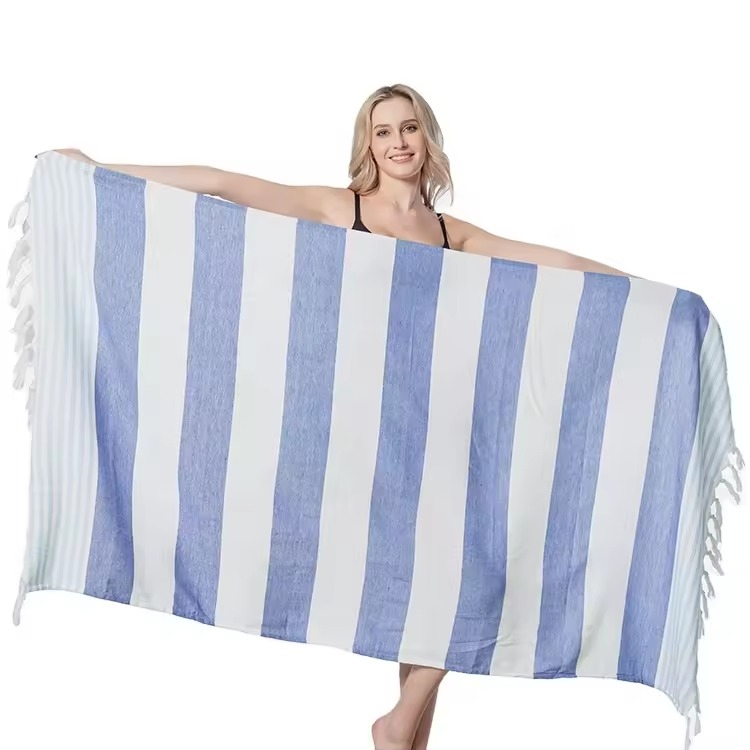
For example, a hypothetical towel with a 160 cm body and 5 cm fringe at each end has a 170 cm overall length when the fringe is laid out. Calling both products “160 cm” without stating the basis can create a meaningful difference in coverage. The example explains the measurement; it is not a specification for the photographed towel.
Round and Hooded Towels Need Different Measurements
Round towels: diameter is the widest span
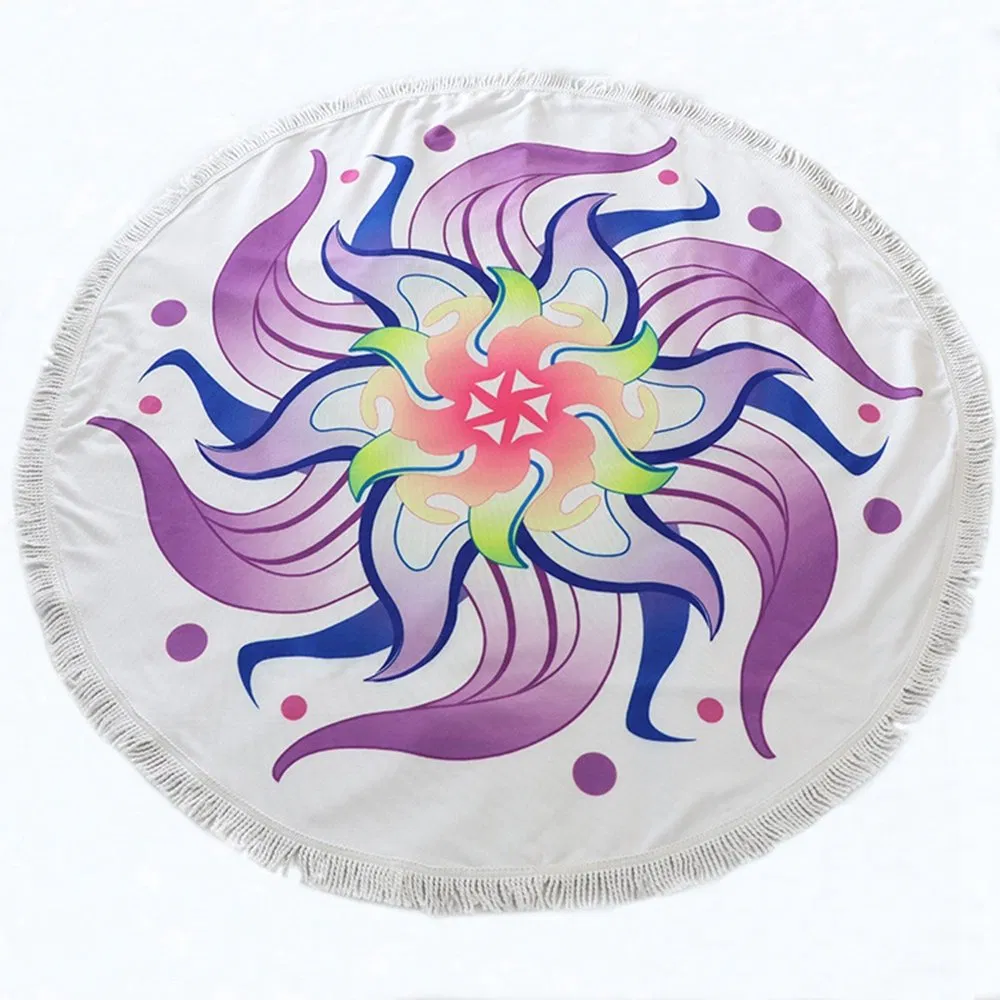
Measure across the center of the fabric body and state whether fringe is excluded. Check across another direction as well. A 150 cm diameter circle has a maximum straight span of 150 cm through its center, but less room on either side of that centerline. It therefore does not provide the same footprint as a 150 × 150 cm square.
For a geometric comparison, a 150 cm circle has approximately 1.77 m² of area, while a 150 cm square has 2.25 m². Round towels can suit seated beach setups and circular artwork; a rectangle generally aligns more directly with a lounger. Choose from the required footprint, then review the folded sample.
Hooded towels: separate the body from the hood
A single overall rectangle cannot describe wearable fit. Depending on the design, specify the flat body width, shoulder-to-hem length, front and back lengths, hood height and depth, and relevant openings. Mark exactly where each measurement starts and ends. Review the worn sample for coverage and movement; an overall dimension including the hood is not equivalent to the length of a flat beach towel.
How Size and GSM Affect Towel Weight
GSM means grams per square meter: the mass of fabric over an area. It is different from the weight of one complete towel. Fabric mass per unit area is the subject of ASTM D3776/D3776M; a finished product also includes construction details that a simple area calculation may not capture.
Rectangular fabric mass estimate in grams = width in meters × length in meters × GSM.
Swipe or scroll horizontally to see all columns →
| Dimensions | Area | Calculation | Estimated fabric mass |
|---|---|---|---|
| 80 × 160 cm | 1.28 m² | 0.80 × 1.60 × 400 | 512 g |
| 100 × 180 cm | 1.80 m² | 1.00 × 1.80 × 400 | 720 g |
At the same GSM, the larger example uses about 40.6% more fabric area and has 208 g more calculated fabric mass. That does not mean its selling price or freight will rise by exactly 40.6%: cutting layout, processing, decoration, packing and other costs also matter.
Treat the formula as a planning estimate. Hems, borders, fringe, embroidery, labels and differences in fabric construction can change the finished piece weight. Weigh the approved dry sample and record its actual packed weight for shipping. For a round towel, use π × radius² for the body area; do not calculate it as diameter × diameter.
Size and GSM alone cannot establish softness, absorbency or drying performance. Compare the actual constructions in our beach towel material guide, then sample the combination that suits your product.
Check Artwork and Packaging Before Fixing the Size
Changing the towel proportions can change the design. An 80 × 160 cm towel has a 1:2 width-to-length ratio; 100 × 180 cm has a 1:1.8 ratio. Enlarging artwork uniformly to one dimension can leave extra space or require cropping in the other. Ask for a layout at the final dimensions, with logo placement measured from the finished edges.
Keep the usable design area distinct from hems, decorative borders and fringe. Review how the design sits when the towel is laid flat, wrapped and folded for display. Printing, jacquard and embroidery have different layout considerations; use the beach towel logo guide when choosing the method.
Approve the folded format separately from the unfolded size. For example, folding an 80 × 160 cm rectangle in half across its width and twice along its length produces a nominal 40 × 40 cm footprint. This geometric example says nothing about the folded thickness. Fabric loft, hems, compression and packaging determine the space the real product needs.
Request folded length, width and thickness, individual packed weight, pieces per carton, carton dimensions and gross weight. Compare quotations using the same fold and packaging. A pouch that fits an unbranded sample may fit differently once a band, insert or bulky embroidered area is added.
Approve Dimensions Before and After the Agreed Care Process
Record the supplied size and the size after the agreed washing and drying procedure. Specify the procedure and number of cycles, rather than writing “wash tested” without details. ISO 5077 describes determining textile dimensional change after specified washing and drying procedures; it does not give one universal acceptable shrinkage percentage for every towel.
A simple calculation makes the result clear: if a sample length changes from 160 cm to 155.2 cm, the change is (155.2 − 160) ÷ 160 × 100 = −3%. That is an arithmetic example, not a predicted result or an acceptance limit. Measure width separately and agree the limits for your product and care conditions.
At TowelWise, we retain the approved sample and agreed specifications as the bulk production reference. Sample making takes 5–9 days; shipping time is separate. Bulk production takes 15–30 days, separate from sampling and shipping. See sample development for the current process and discuss the schedule for your specific project.
Beach Towel Size Questions
Send a Complete Sizing Brief
Use this checklist when requesting a quote or approving a sample:
- Use and audience: drying, lounging, wrapping, travel, hotel use or a wearable hooded design.
- Shape and dimensions: width × length, round diameter, or a labeled body-and-hood drawing.
- Measurement basis: controlling unit, finished body versus overall size, fringe treatment and measurement condition.
- Material and weight: fiber composition, construction, target GSM and requested finished piece weight.
- Artwork: logo method, orientation and position relative to finished edges.
- Approval criteria: agreed dimensional tolerances, care procedure and post-care requirements.
- Order and packing: quantity by color and size, fold, packaging, destination and required delivery date.
Our minimum bulk order is 50 pieces per color. Send the proposed size breakdown so the quotation can cover the complete specification. A marked-up reference towel or simple measured sketch is enough to start the sizing discussion.
Related Guides & Product Resources
- Beach Towel Materials: How to Choose the Right Fabric
- Beach Towel Logo Methods: Printing, Jacquard & Embroidery
- Custom Beach Towel Styles & Specifications
- Beach Towel Sample Development
- Beach Towel Design Gallery
Send your preferred shape, finished body dimensions, whether fringe is included, fabric, quantity per color and delivery destination. A reference photo or an existing towel helps us review the size and prepare a sample.
Discuss Your Towel Size