
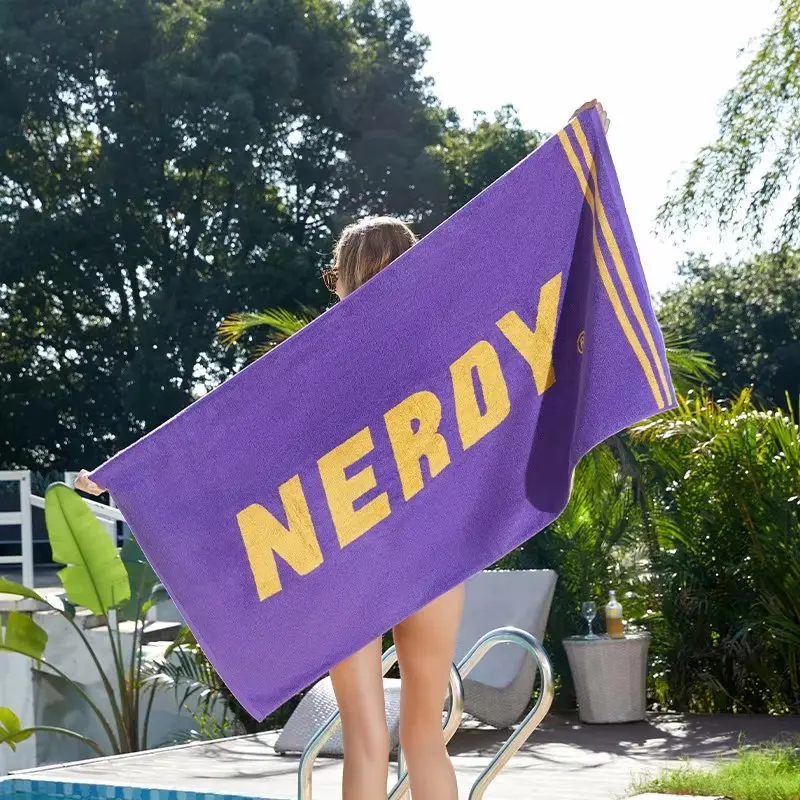
Choose printing for illustrations, photographs and large graphic areas; jacquard for a design formed within the woven towel; and embroidery for a smaller, raised logo. The best route also depends on the towel's fibers, surface and intended use. A full-color travel towel and a hotel towel with a discreet corner emblem need different specifications.
Start with the material and the artwork together. Reactive printing suits compatible cotton, while conventional dye-sublimation needs a suitable polyester surface. Screen printing describes how color is applied; it does not identify the ink chemistry. This guide explains those differences, the trade-offs behind each option, and what to approve before bulk production. For the available towel styles and branding options, see our custom beach towels.
Which Beach Towel Logo Method Should You Choose?
Use the table to shortlist a route. The final decision should use your actual fabric and artwork; the method name alone cannot establish color accuracy, durability, price or minimum quantity.
Swipe or scroll horizontally to see all columns →
| Method | A useful starting point for | Main check before approval |
|---|---|---|
| Reactive printing | Cotton towels with colorful artwork; detailed images when the application process supports them | Surface detail, color, hand feel and washed sample |
| Screen printing | Bold logos, lettering and defined color areas on a compatible towel | Ink system, color registration, coverage and feel |
| Dye-sublimation | Photographs, gradients and all-over graphics on a suitable light polyester face | Face composition, background color and reverse-side specification |
| Jacquard | Woven lettering, emblems, repeats and coordinated retail collections | Weave interpretation, detail scale and both sides |
| Embroidery | Compact hotel, resort, club and corporate logos | Stitch clarity, density, backing and comfort |
| Woven label or branded band | Secondary identification on a plain or decorated towel | Legibility, attachment, placement and folded presentation |
Printing Terms: Separate the Color System from the Application Method
A quotation saying only “digital print” leaves an important question unanswered: digital printing with which color system, on which fabric? Screen and digital describe application methods; reactive dyes and pigments describe color systems. Sublimation describes a dye-transfer process, and its transfer artwork can be printed digitally.
For example, a cotton print can use reactive dyes applied through a suitable screen or digital process. A pigment system uses a binder to hold color at the surface. Ask the supplier to name both the process and the ink or dye system so that quotations describe the same product. CottonWorks explains the difference between dye and pigment printing and describes digital printing with different colorants.
“Full color,” “soft print” and “high definition” describe a desired result. They do not replace a fabric specification, an artwork review or a physical sample.
Cotton Towels: Reactive Printing and Screen-Printed Logos
Reactive printing: choose it when cotton is part of the brief
Reactive dyes bond with compatible cellulosic fibers such as cotton. They are a relevant route when the brief combines a cotton towel with a substantial printed design. Proper processing includes fixation and washing off residual materials; performance still needs checking on the finished towel. See CottonWorks' explanation of fiber-reactive dyes.
A smooth velour face can make small design details easier to see than a pronounced looped terry surface. That difference matters for an illustrated coastline, thin outlines or a compact logo within a larger repeat. Compare the same artwork on the proposed surface, especially if the artwork was first approved on paper.
Choose this route when retaining the specified cotton construction is important and the design needs colored coverage across a meaningful area. Confirm whether the proposed application method can reproduce photographs or gradients. Do not assume that every reactive-print quotation includes the same detail capability or that the reverse will carry an identical image.
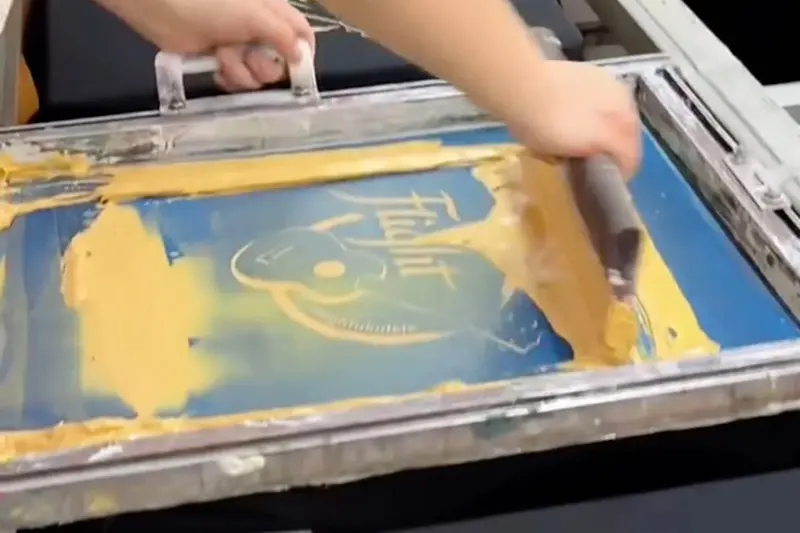
Screen printing: useful for defined logos and bold graphics
A screen controls where color reaches the fabric. Simple emblems, block lettering and separated color areas are useful candidates. For a sponsor towel, a clean two-color composition may communicate more clearly than a very detailed badge enlarged from a small digital file.
Ask which ink system is proposed. If the supplier suggests a pigment system, the binder, coverage and curing affect the result; inspect the printed area for stiffness as well as visual coverage. Pigment printing is discussed here to help you interpret quotations, and its suitability and availability must be confirmed for the specific TowelWise project.
Screen preparation, color separations and registration can influence setup and production. Request a quote for the actual design and quantity rather than assuming screen printing is always the cheapest option. For a photographic scene or many gradients, ask whether a digital route on the chosen fabric would preserve the image more effectively.
Dye-Sublimation: For Photographs and Colorful Polyester Faces
Conventional dye-sublimation uses heat to transfer dye into a compatible polyester surface. White or light backgrounds are the usual starting point because the underlying fabric color affects the image. Sawgrass distinguishes sublimation ink and substrate compatibility; other transfer systems marketed for cotton are different processes and should not be treated as interchangeable.
Consider sublimation for a destination photograph, a multicolor event illustration, gradients or an all-over holiday pattern on an appropriate polyester towel. Review pale details, dark areas, skin tones and fine lettering at the intended output size. A phone preview cannot establish how those details will look across a full beach towel.
A polyester face with a cotton reverse needs a two-sided specification. The polyester side provides the compatible print surface; the cotton reverse is a separate part of the construction. Request the complete fiber composition and the face/back arrangement. A blend percentage alone does not explain which fibers are exposed on each side, and this construction should be confirmed for the proposed product.
Do not specify ordinary dye-sublimation for an untreated 100% cotton towel or assume it will produce the same image on a cotton reverse. A dark base, prominent texture or two different face materials can change the proposal. Approve the print face, reverse appearance, edge finishing and feel as one finished sample.
Jacquard: When the Logo Should Be Part of the Woven Design
Jacquard weaving creates a design through controlled yarn interlacing rather than adding a printed picture to a finished surface. The weaving system determines which patterns can be formed; Stäubli describes individual warp-thread control in Jacquard weaving. The equipment example explains the principle, not the specification of a TowelWise production line.
Choose jacquard for a retail towel built around a bold brand name, a repeat emblem, geometric pattern or coordinated woven border. It is especially worth sampling when the woven texture is part of the collection's appeal. Evaluate the complete design rather than asking to reproduce every pixel of a printed reference.
Fine lettering, narrow gaps and detailed illustrations may need simplification to suit the yarns and weave. A photographic gradient is generally a print-first brief. There is no single color-count rule for all jacquard towels: feasible colors, repeats and detail depend on the proposed construction and loom setup.
Review the reverse carefully. It may have a reversed color arrangement, different yarn exposure or a different visual effect; it is not automatically an identical second face. Ask for both sides of the proposed sample and confirm logo readability, texture, borders and any exposed floats before approving it.
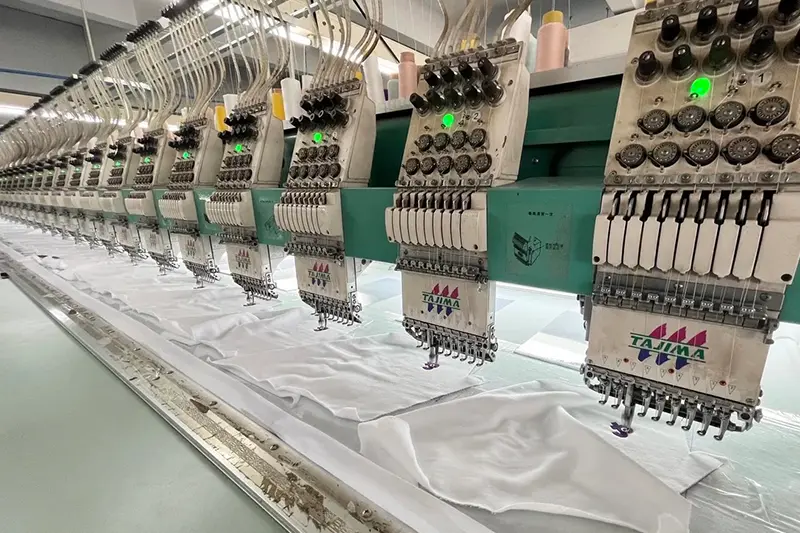
Embroidery: For Smaller Logos with a Raised Thread Finish
Embroidery builds the logo with stitches. It is a useful choice for a discreet resort emblem, club crest or corporate mark when the buyer wants a tactile detail and a largely undecorated towel. A corner or end placement can keep the logo visible while leaving the main drying area comfortable.
The design must be digitized into a stitch plan. Small type, fine outlines and narrow openings can lose clarity in a textured towel. Ask to see the smallest text at the proposed size, and approve any simplification before stitching. Enlarging the mark or removing a tiny tagline can be more effective than adding stitch density.
Backing, topping, stitch density and thread selection affect the result. A topping can help keep stitches above terry loops, as explained in Madeira's guidance for textured fabrics. The suitable combination should be established on the actual towel.
Turn the sample over and feel the reverse. Check backing edges, loose threads, puckering and how the stitched area bends. Dense, broad embroidery can be too firm for an area intended to touch the skin. For a full-surface illustration or a large solid background, compare printing or jacquard instead of scaling embroidery across the towel.
Choose the Method by How the Towel Will Be Used
These are planning scenarios, not fixed production recipes. Start with the result the customer needs, then compare the compatible methods on the same fabric, size and quantity.
Swipe or scroll horizontally to see all columns →
| Application | Route to consider | Why and what to check |
|---|---|---|
| Hotel or resort with a small emblem | Embroidery on a suitable cotton towel | Visible brand detail with open drying space; check backing comfort and the intended laundry routine. |
| Sports event with large sponsor lettering | Screen print on compatible fabric; reactive or sublimation route as the fabric requires | Prioritize readable lettering at a distance; check each sponsor mark and color registration. |
| Travel or souvenir range with photographs | Sublimation on a polyester face; suitable digital reactive print for a cotton brief | Review image detail, gradients and color on the actual surface. |
| Retail collection with a woven brand pattern | Jacquard | Make the woven design part of the product; approve repeat placement and reverse appearance. |
| Children's towel with a colorful illustration | Fabric-compatible printing | Preserve character detail; check orientation when wrapped, folded or made into a hooded style. |
| Corporate gift with restrained branding | Small embroidery plus a label or paper band | Separate permanent identification from gift presentation; check the folded sample. |
| Minimal plain towel with a small brand signature | Woven label or a woven branding detail where feasible | Keep the main field plain; check label legibility, seam attachment and skin contact. |
A woven label is a separate sewn-in identifier; jacquard forms a design within the towel fabric. A removable band identifies the product while packed. Neither automatically replaces the visible main logo once the towel is opened. Specify permanent branding and packaging branding separately.
Other branding options: embossing and patches
Embossing is worth discussing when the brief calls for a restrained logo expressed through surface relief rather than a large colored graphic. TowelWise lists embossing among its options on suitable fabrics; feasibility must be checked against the selected towel construction. Assess how clearly the mark reads in different lighting, how the treated area feels and whether its appearance is retained after the intended wash routine. Do not assume that a result on one fabric can be repeated on cotton terry, velour and microfiber alike.
Embroidered, silicone, rubber or leather patches can provide a distinct brand badge on a largely plain towel or add a separate identifying detail beside a printed design. Choose the patch material to suit the desired appearance and feel, then confirm its size, placement and attachment on the actual towel. Review the patch edges and reverse for comfort, check that the attachment does not distort the fabric, and wash the assembled sample under the intended care conditions. A patch's appearance in isolation does not establish how the complete towel will perform.
How to Prepare Artwork and Logo Placement
Confirm the towel's finished size and orientation before fixing the artwork. A design that looks balanced on a small mockup may move into a folded edge or become difficult to read when the towel is wrapped around the body.
- Send the best original artwork. TowelWise accepts AI, PDF, PSD, JPG and PNG files or a physical reference. Vector artwork is useful for clean logos; a file extension alone does not guarantee that its contents are editable vectors.
- State the output size. Give the logo width and height, towel dimensions and units. For raster images, ask for a resolution review at that final size. There is no single DPI requirement suitable for every towel, image and process.
- Mark placement from finished edges. Identify the top, bottom, front and back. Separate the finished hem from any artwork bleed, and agree a safe area for text and critical details.
- Supply color references. Include the brand color codes and a physical reference when available. Monitor colors, printed paper, yarns and towel fibers do not give an automatic exact match; approve the material sample.
- Flag the smallest details. Ask the factory to review thin strokes, small type, tight gaps and fine outlines. Keep a simplified version of the mark available if the construction requires it.
- Specify every branded surface. Include reverse artwork, labels, bands, packaging and the appearance after folding or rolling. Do not leave the second face to interpretation.
Placement example: make the brief measurable
On an illustrative 80 × 160 cm towel, a 24 cm-wide logo centered across the 80 cm width leaves 28 cm from each side edge to the logo's bounding box: (80 − 24) ÷ 2 = 28 cm. Separately state the distance from the finished bottom edge to the logo. These numbers explain the layout; they are not production tolerances or a recommended logo size for every method.
For all-over artwork, obtain the production layout before adding bleed. For jacquard and embroidery, approve the factory's interpreted design as well as the original artwork, since weaving and stitches have different constraints.
What Changes the Cost, Quantity and Production Proposal?
Compare complete specifications, not a price per logo. Towel fabric, size and weight affect the base product; decoration adds its own preparation, coverage and processing requirements. Review the material selection guide before treating different fabric quotes as equivalent.
- Screen printing: color separations, screen preparation, repeat setup and registration.
- Digital printing or sublimation: artwork area, print route, fabric preparation and finishing.
- Jacquard: yarn selection, construction development, pattern setup and order mix.
- Embroidery: digitizing, stitch count, logo area, placements and thread changes.
- Labels and bands: separate artwork, component quantities, attachment and packing work.
Ask for any setup costs and the applicable minimum for each design, color and construction. Changing a logo across several small batches can create a different quote from one repeated design. No method is universally cheapest; request alternatives against the same requirements.
What to Check on the Sample Before Bulk Production
Use a physical sample to connect the approved artwork with the finished towel. Photos are helpful for placement, but they cannot establish softness, reverse-side comfort or how a dark printed area feels after washing. Our beach towel gallery provides visual references; the order sample should represent your agreed construction.
- Identity and layout: correct artwork revision, spelling, logo proportions, orientation, position and repeat.
- Front and reverse: agreed colors, coverage, second-side appearance, unwanted show-through and any embroidery backing.
- Surface and comfort: feel both decorated and undecorated areas; inspect stiffness, puckering, snag-prone threads and edge finishing.
- Small details: check the finest lines and smallest letters at normal viewing distance, not only in a magnified photo.
- After washing: follow the intended care instructions, record the washing and drying conditions, and compare color, shape, texture, stitching and logo appearance with an unwashed reference.
- Presentation: check labels, folded logo visibility, bands, bags and the complete packed towel.
For pool, outdoor or commercial-laundry use, tell the supplier the actual conditions and agree any relevant performance tests and acceptance criteria. A home wash check is useful for development but does not substitute for a specified laboratory test or establish a durability claim.
Record the sample version, approved colors, measurements and acceptable tolerances, then keep the agreed sample as the production reference. TowelWise's sample development process lists custom samples at US$10–30 and sample making at 5–9 days, with shipping confirmed separately. Confirm the schedule and sample route for your proposed design before placing the order.
Frequently Asked Questions
Related Guides & Product Resources
- Beach Towel Size Guide: Dimensions, Shapes & Buying Tips
- Beach Towel Materials: How to Choose the Right Fabric
- Custom Beach Towel Styles & Specifications
- Beach Towel Sample Development
- Beach Towel Design Gallery
Send your logo or artwork, finished towel size, fabric preference, design placement, quantity per color and destination. We will review the decoration method and the details to confirm on a physical sample.
Review Your Towel Design